


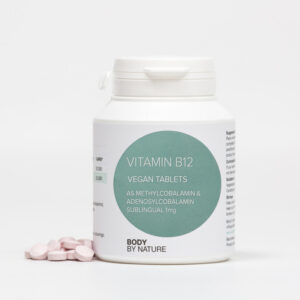
If you’ve ever shopped for a vitamin B12 supplement, you’ve probably noticed there isn’t just one type. Two names show up again and again: Methylcobalamin and Cyanocobalamin.
So what’s the difference—and does one actually work better than the other?
In this Body by Nature Supplements guide, we’ll break down Methylcobalamin vs Cyanocobalamin in plain English: what each form is, how the body uses them, who might prefer one over the other, and how to choose without getting lost in the marketing.
First: why vitamin B12 matters
Vitamin B12 (cobalamin) supports several essential functions, including:
- Normal energy-yielding metabolism
- Red blood cell formation
- Nervous system function
- Normal psychological function
Because B12 is involved in both energy and nerve health, low levels can show up as fatigue, brain fog, tingling, or mood changes. That’s why choosing a B12 supplement can feel like a big deal.
What is cyanocobalamin?
Cyanocobalamin is a synthetic form of vitamin B12. It’s widely used in supplements and fortified foods because it’s:
- Stable (long shelf life)
- Cost-effective
- Well-studied
Your body can use cyanocobalamin, but it typically needs to be converted into active forms of B12 before it can be used in key processes.
Why does it have “Cyano” in the name?
Cyanocobalamin contains a cyanide molecule in its structure. This sounds alarming, but the amount is tiny. The body removes it during conversion, and it’s generally considered safe for most people at typical supplement doses.
Still, some people prefer to avoid it on principle and choose other forms.
What is Methylcobalamin?
Methylcobalamin is often described as an “active” form of vitamin B12. It’s one of the forms the body uses directly in certain biochemical reactions.
It’s popular because:
- It’s a naturally occurring form
- It’s often marketed as “ready to use”
- Many people report they feel great on it
When comparing methylcobalamin vs cyanocobalamin, methylcobalamin is usually positioned as the premium option.
Methylcobalamin vs cyanocobalamin: the key differences
Let’s put the comparison into a few simple categories.
1) Conversion and “active” status
- Cyanocobalamin generally needs conversion into active forms.
- Methylcobalamin is already one of the active forms used by the body.
For many people, conversion isn’t a problem. But if you’re someone who wants the simplest path—or you suspect you don’t convert as efficiently—methylcobalamin can be appealing.
2) Stability and shelf life
- Cyanocobalamin is very stable, which is one reason it’s common.
- Methylcobalamin can be less stable in certain conditions (depending on formulation).
This doesn’t mean methylcobalamin is “bad,” just that quality manufacturing and storage matter.
3) Cost
- Cyanocobalamin is usually cheaper.
- Methylcobalamin often costs more.
If budget is a factor and you’re choosing between “some B12 consistently” vs “the perfect form occasionally,” consistency usually wins.
4) Personal response
This is the part people don’t love hearing, but it’s true: different people respond differently.
Some people feel noticeably better on methylcobalamin. Others do perfectly well on cyanocobalamin and notice no difference at all.
Who might prefer methylcobalamin?
You may lean toward methylcobalamin if you:
- Prefer an active form of B12
- Want to avoid cyanocobalamin for personal reasons
- Have previously tried cyanocobalamin and didn’t feel much difference
- Are looking for a more “premium” B12 option
It’s also popular in sublingual (under-the-tongue) lozenges and sprays, which some people find easier to take.
Who might prefer cyanocobalamin?
Cyanocobalamin can be a good choice if you:
- Want a reliable, widely used form
- Prefer a more budget-friendly option
- Are taking a multivitamin that includes B12
- Want something stable with a long shelf life
For many people, cyanocobalamin is a practical, effective option—especially when taken consistently.
What about absorption? (Tablets vs sprays vs sublingual)
When people compare methylcobalamin vs cyanocobalamin, they often forget another big variable: how you take it.
B12 supplements come in several formats:
- Swallowed tablets/capsules
- Sublingual lozenges (dissolve under the tongue)
- Oral sprays
Some people prefer sublingual or spray formats because they’re easy and feel more immediate. But the best option is the one you’ll actually take daily.
If you have known absorption issues (for example, certain digestive conditions), it’s worth speaking to a healthcare professional for personalised advice.
How do you know if you need B12 at all?
If you’re experiencing symptoms that could be linked to low B12, the most reliable step is a blood test.
You may also be at higher risk of low B12 if you:
- Follow a vegetarian or vegan diet
- Are over 50
- Have digestive issues that affect absorption
- Take certain medications long-term
A test helps you avoid guessing—and helps you choose the right dose and approach.
So… which is better?
Here’s the honest answer: “better” depends on your goals and your body.
- If you want a widely used, stable, cost-effective option, cyanocobalamin is a solid choice.
- If you want an active form and prefer a more premium option, methylcobalamin may be the better fit.
In the methylcobalamin vs cyanocobalamin debate, the best choice is the one that matches your preferences, your budget, and your consistency.
Final thoughts
Choosing a B12 supplement doesn’t need to be complicated. Both forms can support healthy B12 intake, and both are commonly used. The real win is making sure your levels are where they should be—especially if you’ve been feeling tired, foggy, or run down.